Standards comparison by licensure
The following image provides a visual overview of how BCCNM practice standards differ across various nursing licensures.
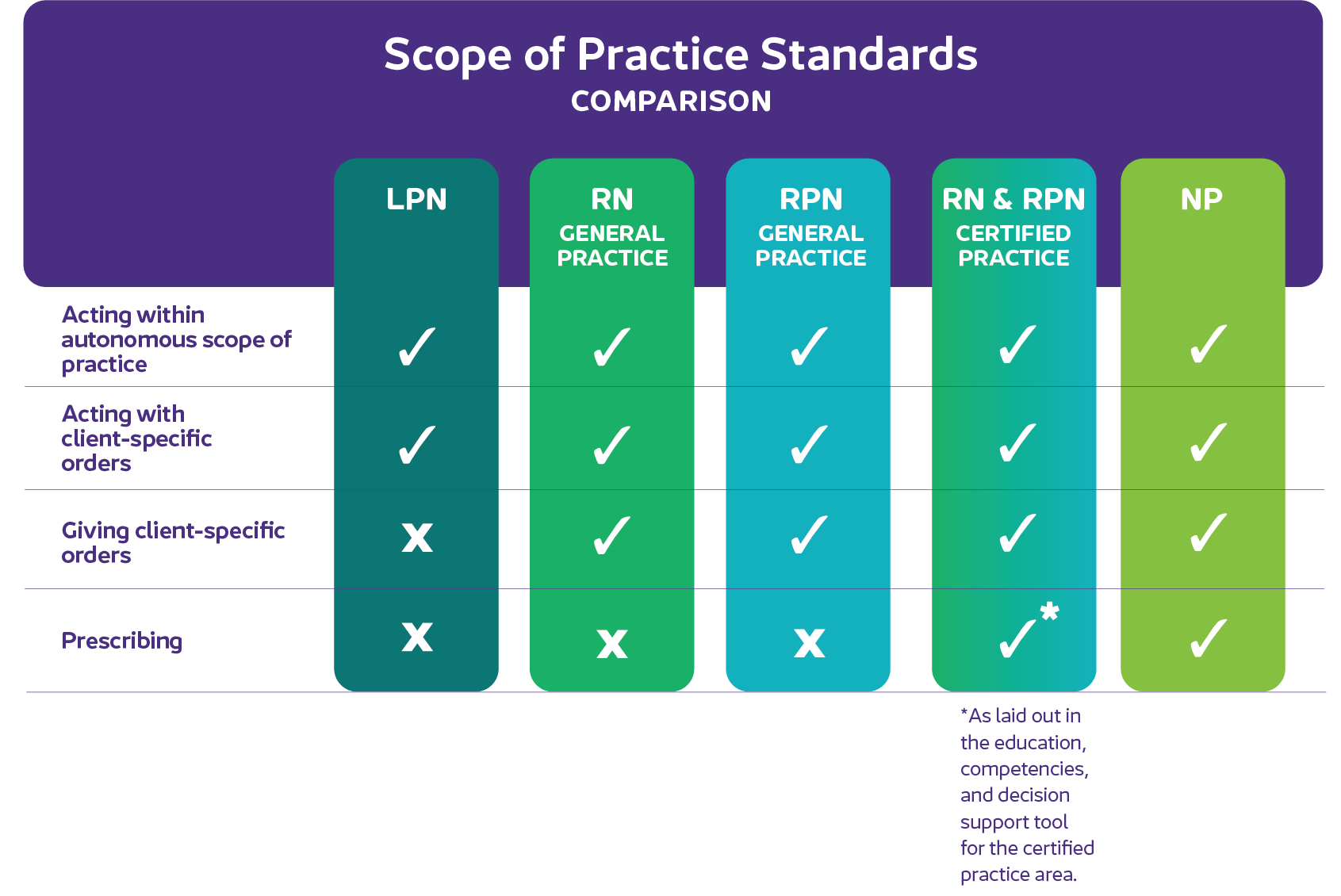
Scope of practice
Scope of practice describes what a nurse is educated, competent, and legally authorized to do. It is shaped by:
- Provincial regulation (set by government)
- BCCNM bylaws, ethics, and practice standards
- Employer policies and processes
- The nurse's individual competence
Nursing profession scope of practice
All nurses must practise within the profession's scope as set out in the
Nurses and Midwives Regulation (NMR) and the
Regulated Health Practitioners Regulation (RHPR) (together referred to as “Regulation").
Controls on practice
The Regulation sets out the restricted activities nurses may be authorized to perform based on their class of licensure. In practice, nurses do not perform every authorized activity because nursing practice is also shaped by four controls on practice—legislation and regulation, BCCNM bylaws, standards, employer policies, and the nurse's individual competence. Each control impacts what a nurse may perform in a specific role and setting.
Read more about controls on practice: LPN, RN,
RPN.
Individual nurse scope of practice
An individual nurse's scope of practice is the specific range of activities a nurse can perform in their role and setting, within the profession's legislated scope.
Nurses determine their individual scope by considering whether the activity is:
- Authorized (per Regulation and BCCNM bylaws, standards, limits, and conditions)
- Permitted in the practice setting (employer policies, procedures, and available resources)
- Within their competence for this client and situation (knowledge, skills, ability, and judgment, and appropriate supports)
Because roles and settings differ, two nurses may have different individual scopes even within the same profession.
Applying scope in practice: quick checks
Before performing an activity, ask:
Scope of practice includes not only what a nurse may do, but also the responsibility to practise safely and ethically, use professional judgment, document appropriately, and seek guidance or additional education when needed.
For a detailed exploration of scope of practice, check out our learning modules:
LPN,
RN,
RPN.
Key concepts
This section outlines terms and concepts related to nursing scope of practice.
- Autonomous scope of practice
Autonomous scope of practice refers to the activities and responsibilities that a nurse is educated, competent, and authorized to perform
autonomously, without authorization from another regulated health-care professional. Nurses acting within their autonomous scope assume accountability and responsibility for:
Autonomous scope of practice does not include any activities, care, or services excluded under BCCNM standards, limits, and conditions.
- Client-specific order
Client-specific order often just called an 'order', is when a regulated health professional authorizes a nurse to perform an activity for a specific client. A client-specific order can include non-restricted or restricted activities. For an order to be complete and safe, it must be legally authorized, client-specific, documented, detailed, and signed.
Competence is the integration and application of current knowledge, skills, ability, and judgment required to perform safely, ethically, and appropriately within an individual's practice.
- Nursing diagnosis
Nursing diagnosis is a nurse's clinical judgment about a client's physical or mental condition based on the client's signs and symptoms. It identifies conditions (not diseases or disorders) that a nurse can address through nursing care—meaning the condition can be prevented, improved, managed, or resolved using interventions that are within the nurse's autonomous scope of practice, without needing another regulated health professional to first assess or diagnose the client.
Certified nurses may diagnose a limited number of specific diseases or disorders, as outlined in their certification program and following their certification program-specific decision support tools.
- Prescribe
Prescribe is to issue a prescription (written or electronic) for a pharmacist to dispense a specified medication to a specific client. Prescriptions can also be issued for medical devices. BCCNM only authorizes certified nurses and nurse practitioners to prescribe.
- Regulated health professional
Regulated health professional is a health professional licensed with a profession's regulatory body. They meet specific requirements to hold a licence and abide by the bylaws and standards set by their regulatory body. Not all health providers are regulated – for example, homeopaths, and care aides are unregulated.
- Restricted activities
Restricted activities are clinical activities that pose a risk of harm to the public and reserved for regulated health professionals, like nurses. These include restricted activities that do not require an order and restricted activities if ordered or certified.