What is regulatory supervision?
Regulatory supervision is a
professional decision-making process midwives use when students perform client care activities that require midwifery knowledge, skill, ability, and judgment. It protects clients while supporting student learning.
Applies to: student midwives in clinical placements and, in some settings, students from other regulated health professions when midwives supervise their entry-level practice.
Bottom line: clinical practice consolidates learning. Students are required to have gained sufficient knowledge, skills, ability, and judgment to perform the activity under supervision through their program.
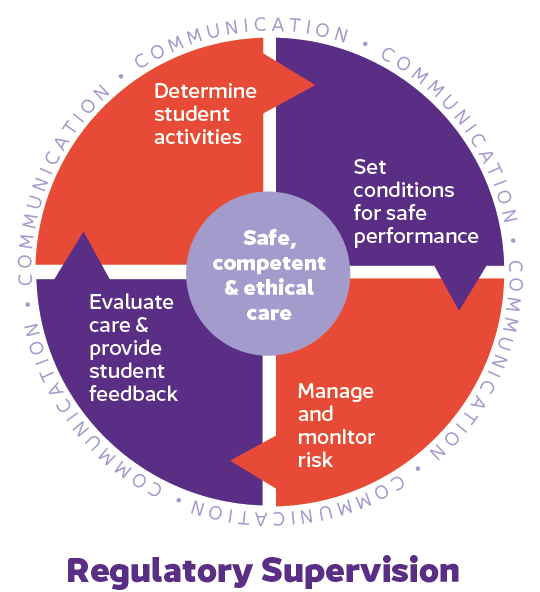

Regulatory supervision process
Use this scenario to follow along as you learn each step of the supervision process.
Practice scenario: “I've done this in lab…"
Ava, a midwifery student, confidently offers to perform a vaginal exam and cervical assessment during active labour “independently." The client is uncomfortable, anxious, and has had a prior difficult exam experience. You have not yet assessed Ava's competence in this clinical context.
What should you do next?
Step 1 — Determine student activities
In the moment: A student offers to do an activity.
Your goal: decide what the student can do safely right now based on student knowledge, skill, ability, and judgment, and risk.
What you do
- A. Confirm the activity fits you (the supervising midwife)
-
Proceed only if:
- The activity is within your scope of practice, and
- The activity is within your individual competence
When supervising across professions, ensure the activity fits your scope/competence and aligns with the student's program competency expectations.
- B. Confirm the student's readiness for the specific activity
-
Confirm what the student has gained sufficient knowledge, skills, ability, and judgment through their education program (or equivalent) to safely perform the activity. Use reliable sources such as:
- Program expectations and skill verification/sign-offs
- Instructor or preceptor feedback (education context)
- Observed performance in clinical practice
- The student's understanding of indications, steps, safety checks, and limits
- Documentation of prior supervised practice (where applicable)
What you can say (quick script)
- “Tell me what you've done with this in practice and what you'd do if the client's condition changes."
- “Walk me through how you will approach the client and steps to performing the assessment or something like that."
Common decision traps
-
“They've done it in lab." Lab practice ≠ readiness for complex/high-risk client situations.
-
Staffing pressure. It doesn't change what's safe.
- C. Client consent (when possible)
-
Before the student participates, obtain the client's consent when possible and document according to practice setting expectations.
Ava has practised cervical assessment in lab and observed several exams in practice but has performed only one exam with direct coaching. You decide she will not perform the exam independently.
Step 2 — Set conditions for safe performance
In the moment: You've decided Ava can participate—but not independently.
Your goal: make performance safe by setting conditions and a supervision plan.
In Step 2, you complete two linked actions:
Set the conditions by defining what the student can do, what requires your involvement, and what safeguards must be in place.
Develop the supervision plan by confirming the supervision level and where and when supervision will occur, communication and escalation expectations, and how supervision will be maintained across the shift.
- Supervision options (choose based on risk/student readiness)
-
Direct: you are physically present, able to observe and intervene immediately
-
Indirect: you are on-site/nearby, able to provide timely consultation/feedback consistent with the conditions and can be contacted by phone, pager, technology
-
Virtual: you are not physically present and available through technology
- What you base it on
-
Student readiness: student knowledge, skills, ability, judgment, and support needs
-
Client factors: client's condition, risks, and preferences
-
Activity risk: complexity and risk level of the activity
-
Practice context: practice setting/work environment
-
Supervision team: who else is involved in the supervision. Clarify roles if more than one supervisor
-
Evaluation: how you will evaluate what was done and its effects
- What you can say (quick script)
- “Here's what you'll do, here's what I'll do, and here's where you'll pause."
- “If anything changes, we stop and I step in."
- Set the conditions
Ava may:
Ava does
not perform the exam independently. Ava completes the exam and you remain present for any complex steps and to respond to unexpected findings.
- Supervision plan
-
Level: Direct (you are at Ava's side)
-
When/where: present for the exam; activity pauses if you step away
-
Real-time checks: Ava pauses at agreed checkpoints (e.g., before starting, before any change in plan, and immediately if the client reports increased pain/concerns)
-
Evaluation: you observe in real time, confirm findings, and monitor the client's response during and immediately after the exam
Step 3 — Manage and monitor risk throughout care
In the moment: the student is performing and the situation may evolve.
Your goal: protect the client by anticipating risk, stepping in early, and updating conditions as needed.
- What you do
- What you can say (quick script)
- “Pause there—let's reassess together."
- “I'm stepping in now. We'll debrief after."
During the exam, the client becomes distressed due to discomfort from incorrect hand positioning and a lack of clear communication about what to expect next. You immediately stop the exam, support the client, reassess the plan of care, and coach Ava on respectful, trauma-informed approaches and reflective learning.
Step 4 – Evaluate care and provide feedback
Review the care provided by the student, assessing whether all planned steps were completed safely and effectively and client response and outcomes.
Provide constructive, timely feedback, focusing on clinical reasoning and communication. Guide the student in identifying what they would do differently next time, supporting their learning and accountability.
- Quick debrief with Ava (1–2 minutes)
-
-
What went well? (preparation, communication, client comfort, pausing at checkpoints)
-
What needed intervention—and why? (importance of maintaining client comfort through proper technique, ongoing check-ins, and transparent communication throughout the process)
-
What will you do differently next time? (review landmarks/technique beforehand, agree on exactly when Ava will pause, practise hand positioning and client communication cues)
-
What conditions apply next time? (direct supervision for the exam; Ava may assist with prep/history/documentation; add a “pause before exam begins" checkpoint and a “pause before documenting findings" checkpoint)
Closing: Support safe student participation by setting clear conditions, staying directly involved when accurate assessment findings matter, and updating the supervision plan for next time.
If something goes wrong
If a student's actions harm (or could harm) a client, the midwife:
Key point: You may not be accountable for events you could not reasonably foresee, but you are accountable for appropriate supervision decisions, conditions, communication, and professional judgment.
Communication and learning environment
Midwives who provide regulatory supervision:
- Clarify roles and responsibilities with the student and instructor/faculty as needed
- Support the student to speak up about risks and ensure reporting occurs per policy
- Ensure the student is aware of relevant BCCNM standards and practice setting policies and procedures
- Ensure the student uses the appropriate title when communicating and documenting
- Address professional practice issues promptly and constructively (e.g., boundaries, discrimination)
- Communicate respectfully and act to create a safe learning environment
- Reflect and take action to support culturally safe learning and client care in alignment with the
Indigenous Cultural Safety, Cultural Humility and Anti-Racism practice standard
The 4Q check — Know before you permit
Use before approving any activity:
- What knowledge, skills, ability, and judgment has the student gained through their education program?
- Is this activity within my scope and individual competence?
- What are the risks for this client in this situation?
- What conditions and level of supervision are required—and how will I evaluate outcomes?