
Health Professions & Occupations Act

BCCNM resource centre

The Health Professions and Occupations Act (HPOA) took effect April 1, 2026​, replacing the Health Professions Act (HPA). At the same time, a new, combined nursing and midwifery regulation took effect, complemented by supporting regulations. Most of the changes impact regulatory colleges, as opposed to licensees. There is no change to day-to-day practice for nurses and midwives.

Below are links to resources and information. Don't see what you're looking ​for? Email communications@bccnm.ca

Watch the June 16 webinar

Representatives from BCCNM, the Nurses and Nurse Practitioners of BC, the Midwives Association of BC, and the new Director of Discipline, Benson Cowan, provided an overview of the Health Professions and Occupations Act (HPOA) and what means for nurses, nurse practitioners and midwives in B.C.

What does the HPOA do?

As stated in the Ministry of Health's Health Professions and Occupations Act webpage, the HPOA increases public safety and protection by:

  • Establishing the Health Professions and Occupations Regulatory Oversight Office (Oversight Office) which independently oversees the regulatory colleges.
  • Committing to cultural safety and humility, including requiring regulatory colleges to offer Indigenous support workers for those who have experienced harm and wish to submit a complaint.
  • Enabling the regulation of health occupations, with a more flexible regulatory model for occupations that present a risk of harm to the public.
  • Creating an independent disciplinary hearing process.
  • Requiring regulatory colleges to maintain a public registry that publishes all disciplinary actions against regulated health professionals.
  • Appointing regulatory college board members based on merit and competency​.

How health professions are regulated in B.C.

The Ministry of Health establishes the framework for health professions regulation in two ways:

  • Enacting the legislation that governs professional regulation (the Health Professions and Occupations Act), and
  • Establishing health profession regulations, which set the scopes of practice and the limits and conditions for practice.

Regulatory colleges are responsible for upholding the legislation and regulations, and for establishing bylaws, standards, and limits and conditions that guide and direct health professionals' practice.

How legislation impacts nurse and midwife practice

The practice of nursing and midwifery is shaped by more than just what's legally allowed. It is defined by four controls on practice: legislation, BCCNM bylaws and standards, employer policies, and the nurse or midwife's indiviual competence.

While regulations may authorize certain activities, licensee  can only perform them if permitted by all four controls on practice. Each control may narrow what a licensee is allowed to do, but none can expand beyond what is allowed by the level below.
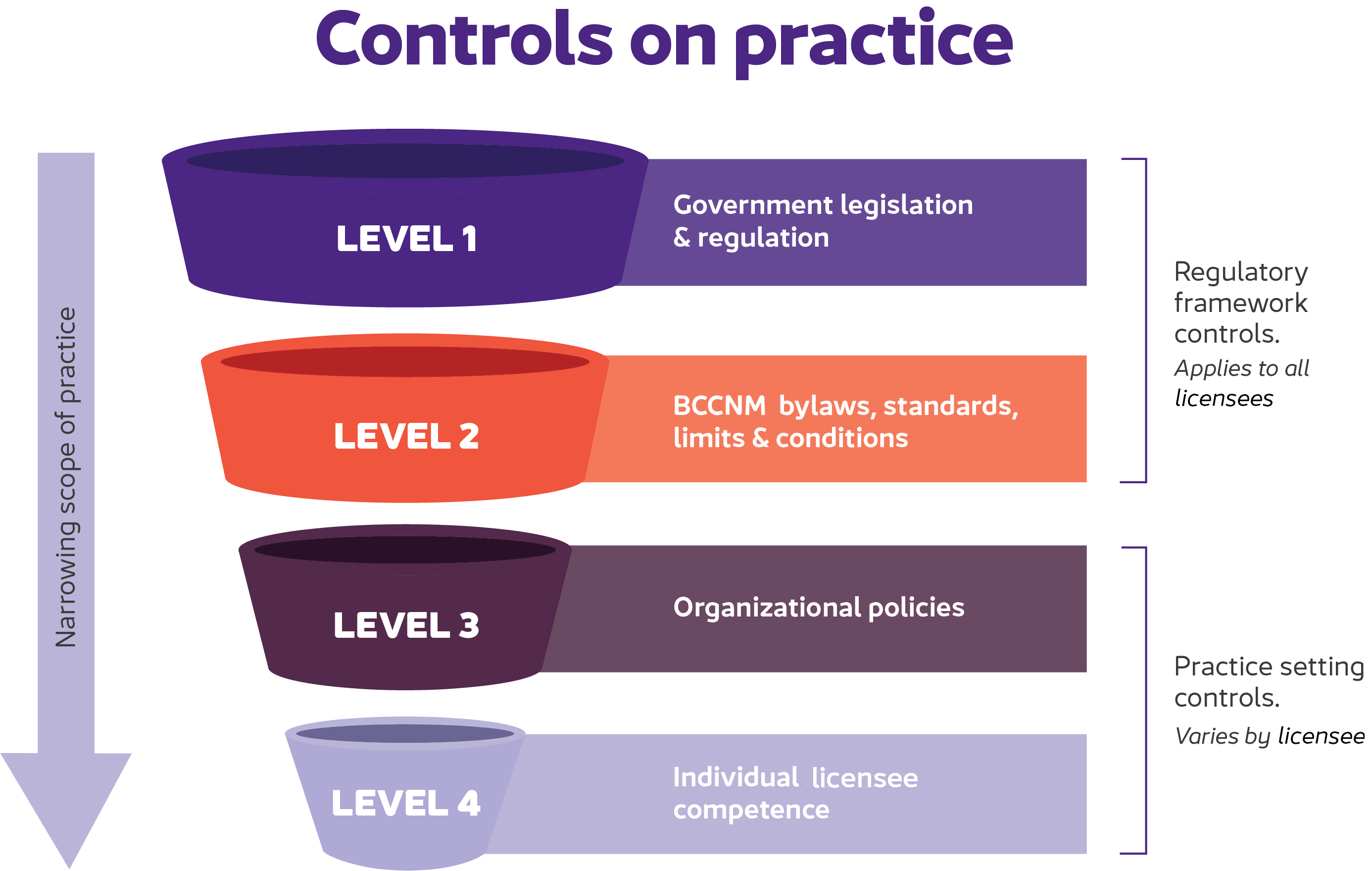

Level 1: Legislation and regulations

This level sets the legal foundation for practice in B.C., through the Health Professions Act (HPA) and the Health Professions and Occupations Act (HPOA) and nursing regulations. These laws ensure that all nurses and midwives provide safe, ethical, and competent care. The legislated scope applies to all licensees, regardless of setting (e.g., hospital, community, long-term care, or self-employment).

Level 2: BCCNM bylaws, standards, limits, and conditions

BCCNM sets practice standards and may place limits or conditions on certain activities authorized in the regulation. Bylaws may also set additional requirements for practice.

Example: BCCNM may require additional education before you are authorized to perform specific activities, like venipuncture. 

Level 3: Organizational policies

Employers may create workplace policies that limit or specify how certain activities are performed. Sometimes, employer policies are more restrictive than legislation or BCCNM standards.

Employer's job descriptions should clearly outline a nurse's expected responsibilities within a specific role. Employers may require additional education or certification for nurses to perform certain activities.

If you are self-employed, you are considered the employer. It is therefore your responsibility to develop appropriate policies and procedures to inform your practice and that of your employees. 

Level 4: Individual nurse or midwife competence

While legislation/regulations, BCCNM standards, and employer policies define what licensees are allowed to do, a licensee's individual competence determines whether the licensee can safely perform an activity.

Competencies are unique to each nurse or midwife and expand with additional education and experience.

The controls on practice help ensure that every activity a licensee performs is safe, appropriate, and within their legal scope of practice. By walking through each level—legislation and regulation, BCCNM standards, employer policies, and their own competence—licensees can determine whether they are authorized and safe to proceed. The final consideration before performing any activity is whether it is in the best interests of the client. Remember, just because you can doesn't mean you should.​​​​

900 – 200 Granville St
Vancouver, BC  V6C 1S4
Canada

info@bccnm​.ca
604.742.6200​
​Toll-free 1.866.880.7101 (within Canada only) ​


We acknowledge the rights and title of the First Nations on whose collective unceded territories encompass the land base colonially known as British Columbia. We give specific thanks to the hən̓q̓əmin̓əm̓ speaking peoples the xʷməθkʷəy̓əm (Musqueam) and sel̓íl̓witulh (Tsleil-Waututh) Nations and the Sḵwx̱wú7mesh-ulh Sníchim speaking Peoples the Sḵwx̱wú7mesh Úxwumixw (Squamish Nation), on whose unceded territories BCCNM’s office is located. We also give thanks for the medicines of these territories and recognize that laws, governance, and health systems tied to these lands and waters have existed here for over 9000 years.

We also acknowledge the unique and distinct rights, including rights to health and wellness, of First Nations, Inuit​ and Métis peoples from elsewhere in Canada who now live in British Columbia. As leaders in the settler health system, we acknowledge our responsibilities to these rights under international, national, and provincial law.​